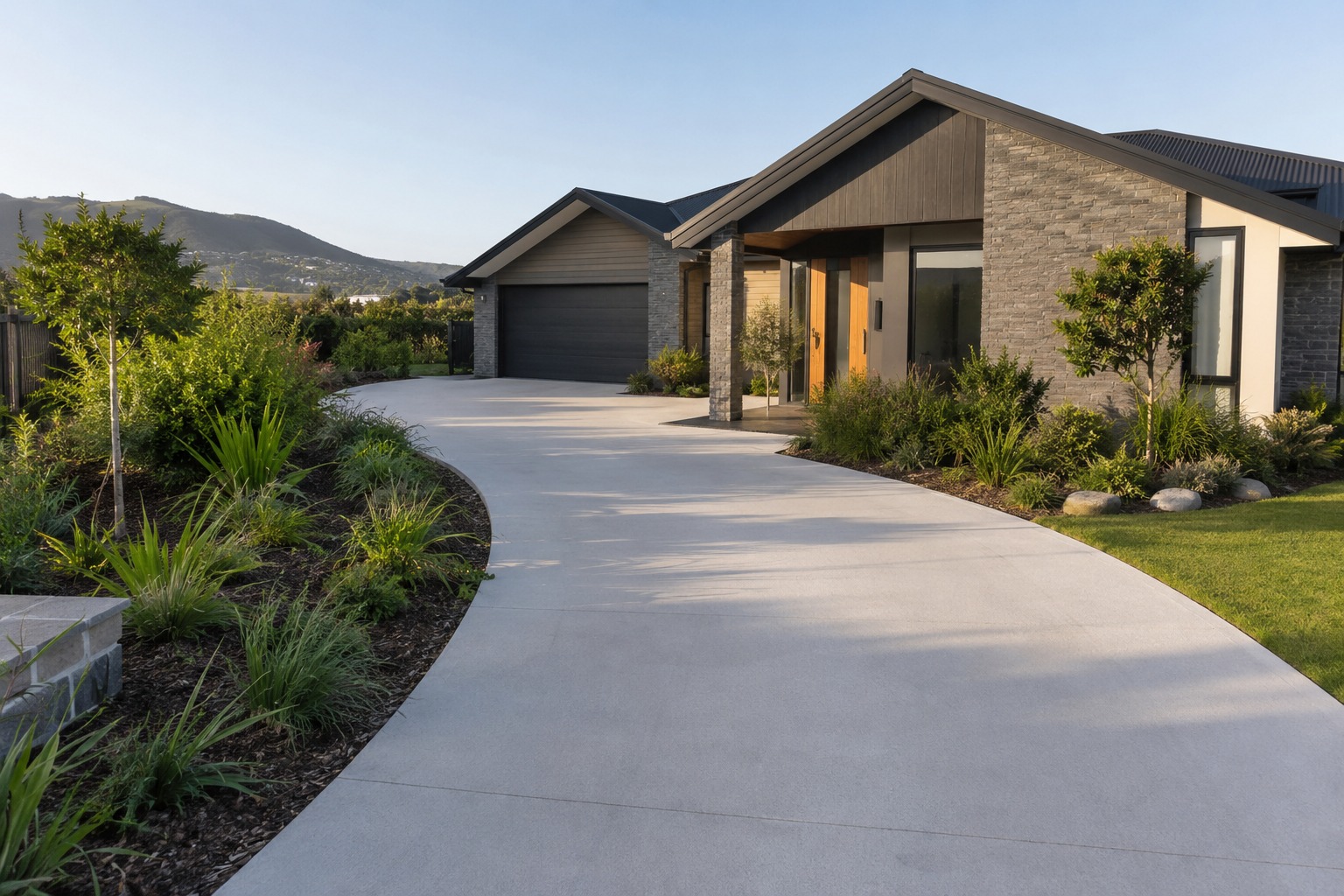
How Thick Should a Residential Concrete Driveway Be in New Zealand?
Concrete driveway thickness is one of those details that's easy to overlook, but it plays a major role in how well your driveway performs over its lifetime. Too thin, and you risk premature cracking under load. Thicker than necessary, and you're paying for concrete you didn't need. Here's how to think about getting it right.
Standard Thickness for Residential Driveways
For typical residential use — cars, utes and light trailers — a slab thickness of around 100mm is the standard starting point for most New Zealand driveways, paired with appropriate steel mesh reinforcement to control cracking and add tensile strength.
This standard thickness assumes a properly prepared, compacted base beneath the slab. Skipping proper base preparation undermines even a correctly specified thickness, since the load-bearing performance of concrete depends as much on what is underneath it as the slab itself.
When You Need a Thicker Slab
If you regularly park heavier vehicles — motorhomes, boat trailers, or trucks — a thicker slab, often 125mm to 150mm depending on the load, along with heavier reinforcement, is worth specifying from the outset rather than risking premature cracking under repeated heavy loads.
Commercial and shared driveways carrying regular truck or machinery traffic typically need an even more robust specification, since the loads involved are well beyond typical residential use and the base preparation needs to match that increased demand.
The Role of Reinforcement Alongside Thickness
Thickness and reinforcement work together, not separately. Steel mesh distributes load across the slab and helps control where shrinkage cracking occurs, meaning a well-reinforced slab of standard thickness can outperform a thicker, poorly reinforced one under the same conditions.
The right combination of thickness and reinforcement depends on your specific site, expected loads and soil conditions, which is why a proper assessment before the pour matters more than simply defaulting to a thicker slab as a blanket solution to every driveway.
Getting the Specification Right for Your Site
Ground conditions vary significantly across Tauranga properties, from stable clay-based soils to areas with softer or more variable fill, and this affects how thickness and reinforcement should be specified for a durable, long-lasting result.
Telling your contractor upfront about expected vehicle loads, and letting them assess your specific ground conditions, ensures your driveway is specified correctly the first time rather than needing costly remedial work later once problems appear.
How Thickness Affects Cost
A thicker slab naturally requires more concrete, which increases material cost, though this is often a relatively small proportion of the total project cost compared to excavation, base preparation and finishing. Specifying the correct thickness upfront is far cheaper than repairing a driveway that has failed under load.
It's worth resisting the temptation to over-specify thickness as a blanket solution for peace of mind, since that money is often better spent on proper base preparation and reinforcement matched to your actual expected use, which has a bigger impact on long-term performance than thickness alone.
Signs Your Existing Driveway May Be Under-Specified
If your current driveway is cracking under normal vehicle use, or showing signs of stress in areas where heavier vehicles regularly park, this can indicate the original slab was too thin or under-reinforced for the loads it's carrying day to day.
This is worth keeping in mind if you're planning to start parking a heavier vehicle on an older driveway that wasn't originally designed for it, since reinforcing or thickening an existing slab isn't possible without breaking it out and repouring.
Working with Council Requirements
Some driveway or crossing work, particularly where it meets a public road or footpath, may need to meet specific council standards for thickness and construction, separate from what is technically required for the driveway itself further back on your property.
It's worth checking these requirements early in the planning process, since council-mandated specifications for the section of driveway crossing the berm can sometimes differ from what you'd otherwise choose for the rest of the driveway on your own land.
Talking to Your Contractor About Thickness
A contractor who asks about your vehicles, how the driveway will be used, and the condition of your ground before quoting is generally giving thickness and reinforcement the attention they deserve, rather than defaulting to a generic specification regardless of your specific circumstances.
If a quote doesn't mention thickness or reinforcement at all, it's worth asking directly what's included, since these details have a real impact on how long your driveway will last and are far easier to get right at the quoting stage than to correct afterward.
Getting thickness and reinforcement right from the start is far cheaper than dealing with cracking or structural issues down the track. If you're planning a new driveway, we're happy to assess your site and recommend the right specification for how you'll actually use it.
← Back to all guides